What survives a future attack?
Hybrid message-key derivation combines classical and post-quantum secret material. The composition and its assumptions remain open to review.
 QuantumShieldLabs
QuantumShield Chat · In development
We’re building a messenger that brings hybrid post-quantum encryption, a locally controlled vault and planned Katzenpost transport into one understandable experience. Built in the open, with evidence you can examine.
Research software. Do not use for safety-critical communications.
The next transport direction
PLANNED INTEGRATIONWe intend to carry QSL’s encrypted conversations over Katzenpost (KP).
Encryption protects what a message says. Timing and routing can still reveal relationships. KP’s mix network adds encrypted routing, mixing delays and cover traffic to address that different problem.
Hybrid message keys protect the conversation before it enters the transport.
Additional encrypted transport and mixing help obscure communication patterns.
The recipient checks the message and saves the authorized state.
This is the intended composition. The two-instance QSL/KP integration proof is still ahead. No completed integration or QSL anonymity guarantee is claimed. Katzenpost is an independent project; this direction does not imply a partnership or endorsement.
The work
A private messenger also needs to get state, identity, delivery and recovery right—especially when something goes wrong.
QSL brings those questions together: protocol drafts, conformance vectors, a Rust client core, a desktop prototype and supporting services. Every component has a specific role. Every security claim needs its own evidence.
How the project fits together →Three questions that guide the research
Go deeper →Hybrid message-key derivation combines classical and post-quantum secret material. The composition and its assumptions remain open to review.
Authentication, bounded work, durable state and exact retries matter as much as the happy path. Rejected input must not earn trusted state.
Our intended KP integration pairs QSL content encryption with a mix network. The real application experiment and its privacy evaluation are still ahead.
Where development stands
Development candidates have passed focused encrypted-storage, tamper-refusal, output-redaction and guarded-deletion checks. The complete vault still needs composition, broader validation and required review before the real QSL/KP experiment.
Explore the roadmap and limits →Snapshot reviewed 2026-11-12. Source pins identify the public repositories; separately labeled progress summarizes development candidates.
The interface taking shape
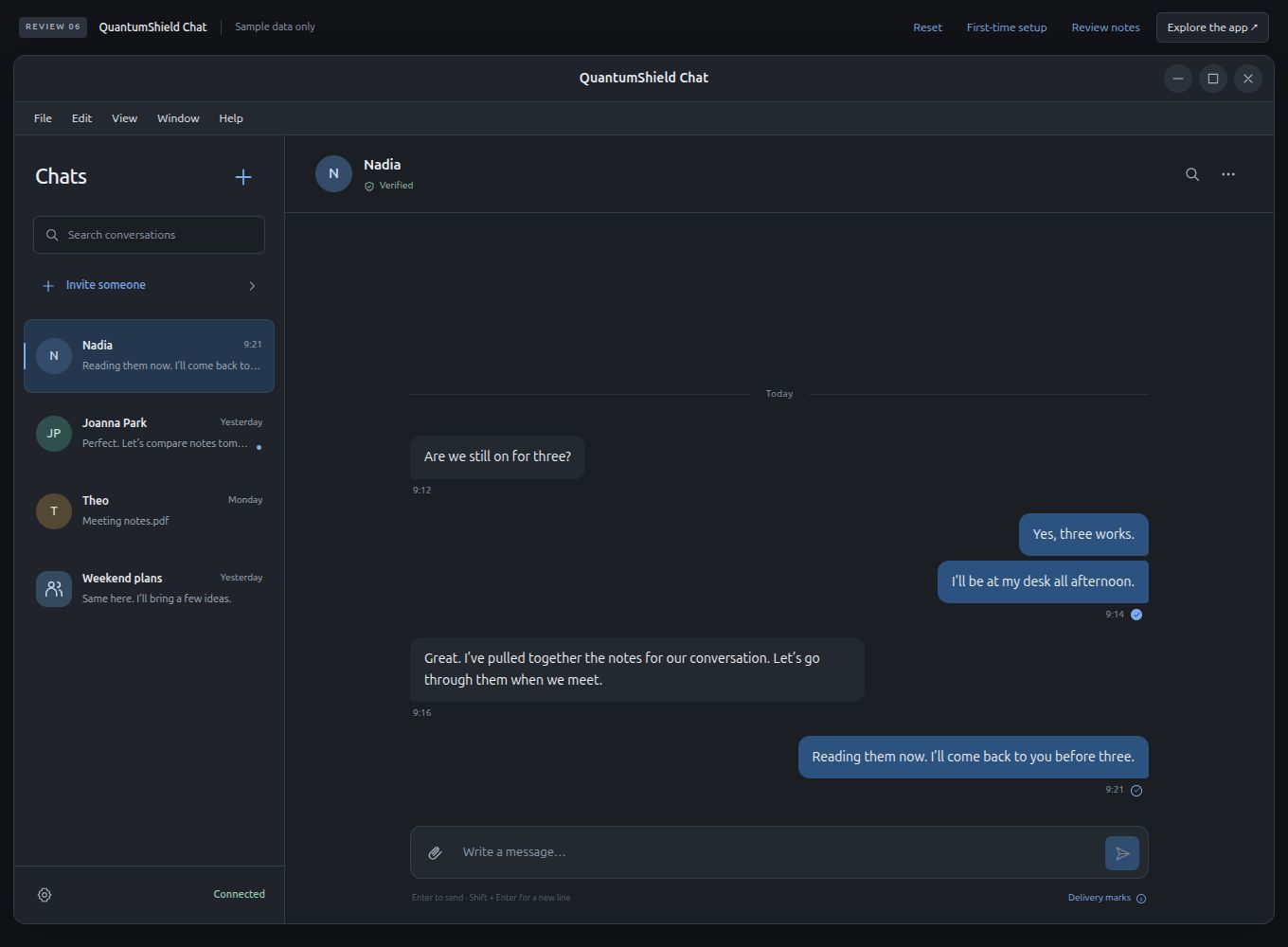
The latest mockups bring contact verification, delivery states and the planned KP connection into view.
Explore the v6 interface preview →“Delivered” should mean something precise.Our design separates network storage, recipient-device delivery and human reading.
One project, clear boundaries
Questions, answered
The intended design puts QSL’s own end-to-end encryption inside KP’s encrypted transport. QSL protects message content; KP’s mixing addresses traffic patterns. The integrated application and its privacy properties still need implementation, measurement and review.
No. The v6 mockups use synthetic data. Messages, verification marks, connection status, groups and other interactions illustrate proposed behavior; they do not demonstrate live cryptography or a working KP integration.
No. The public desktop prototype provides local lifecycle, relay configuration, invitations and contacts. Sending and receiving messages are not available in that application. Use only disposable synthetic data for development.
The research investigates constructions combining classical and post-quantum secret material. Choosing standardized primitives does not establish the security of the entire protocol or application.
That is a research goal, not an established guarantee. Relays can observe queue activity, sizes and timing. Content encryption does not prevent traffic correlation.
No completed independent security audit is established. Internal analysis, bounded models and tests have specific scopes and are not substitutes for external review.
The relay and existing attachment service have open-source development documentation. A local experiment does not establish safe public exposure or production operation.
Reproducible failures, specification ambiguities, missing negative tests and independent implementation work. Start with the affected repository’s contribution and security policies.
Built to be examined